The Weight of Water: Capturing Harlyn Bay and the Cornish Coast in Oil
The north coast of Cornwall has a distinct physical gravity. At Harlyn Bay, where the Atlantic pushes heavy, uninterrupted swells into the curve of the shoreline, the sea rarely feels like passive scenery. Even on clearer days, there is a dense, salt-laden moisture in the air and an undertow that rattles the shingle beneath the surf. It is raw, unpredictable, and entirely shaped by Atlantic weather systems moving fast against the headlands.
Translating that dynamic momentum back into the studio is less about capturing a picturesque holiday view and more about wrestling with mass, force, and light.
Translating the Atlantic Swell Through Impasto
Water is fluid and transient, yet thousands of tons of incoming tide carry enormous structural pressure. Recreating that physical presence on canvas requires a medium with body. Oil paint is uniquely suited to this because it can be worked sculpturally layered thick with a knife to mimic the heave of a breaking crest, or pulled back thin and translucent to suggest the deep water underneath.
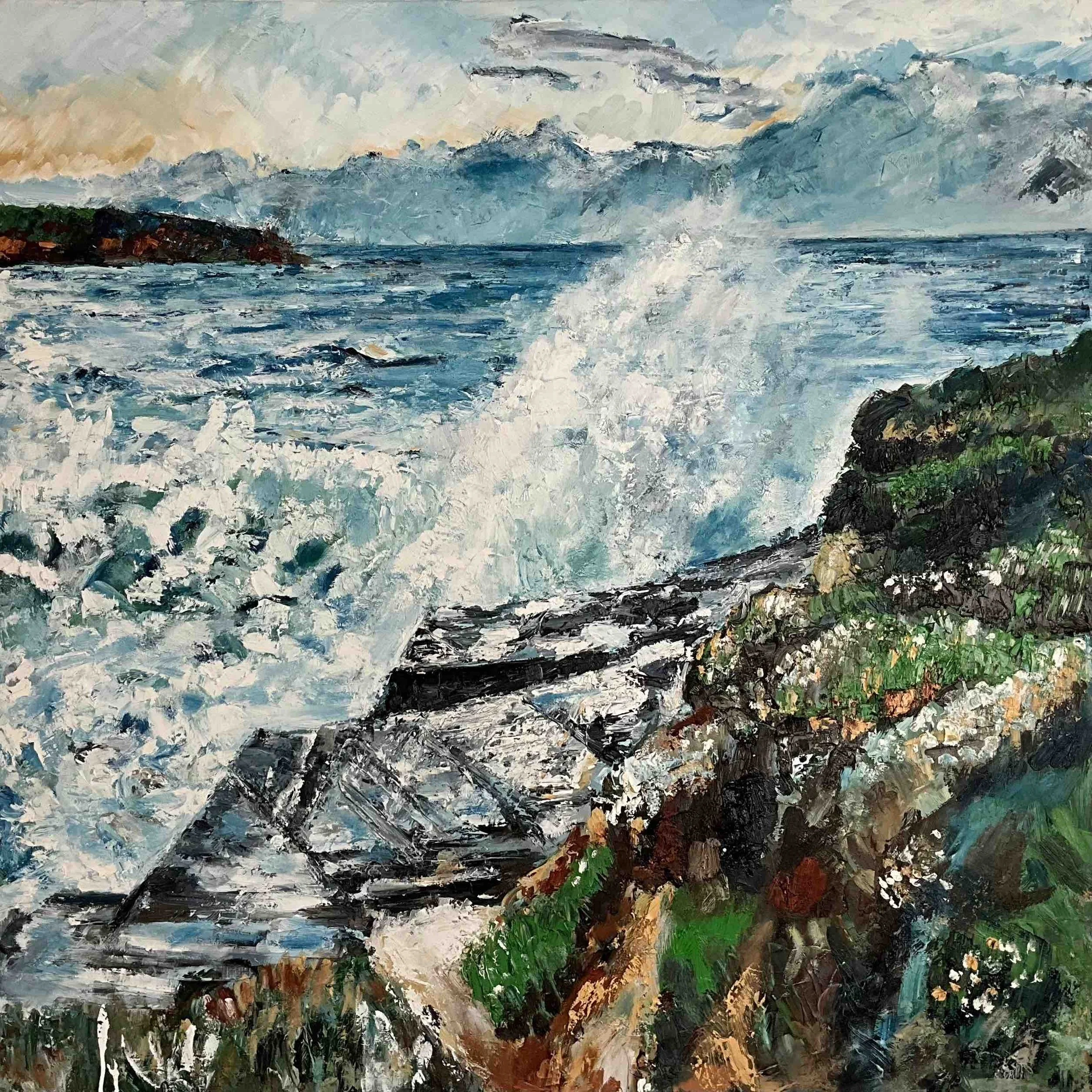
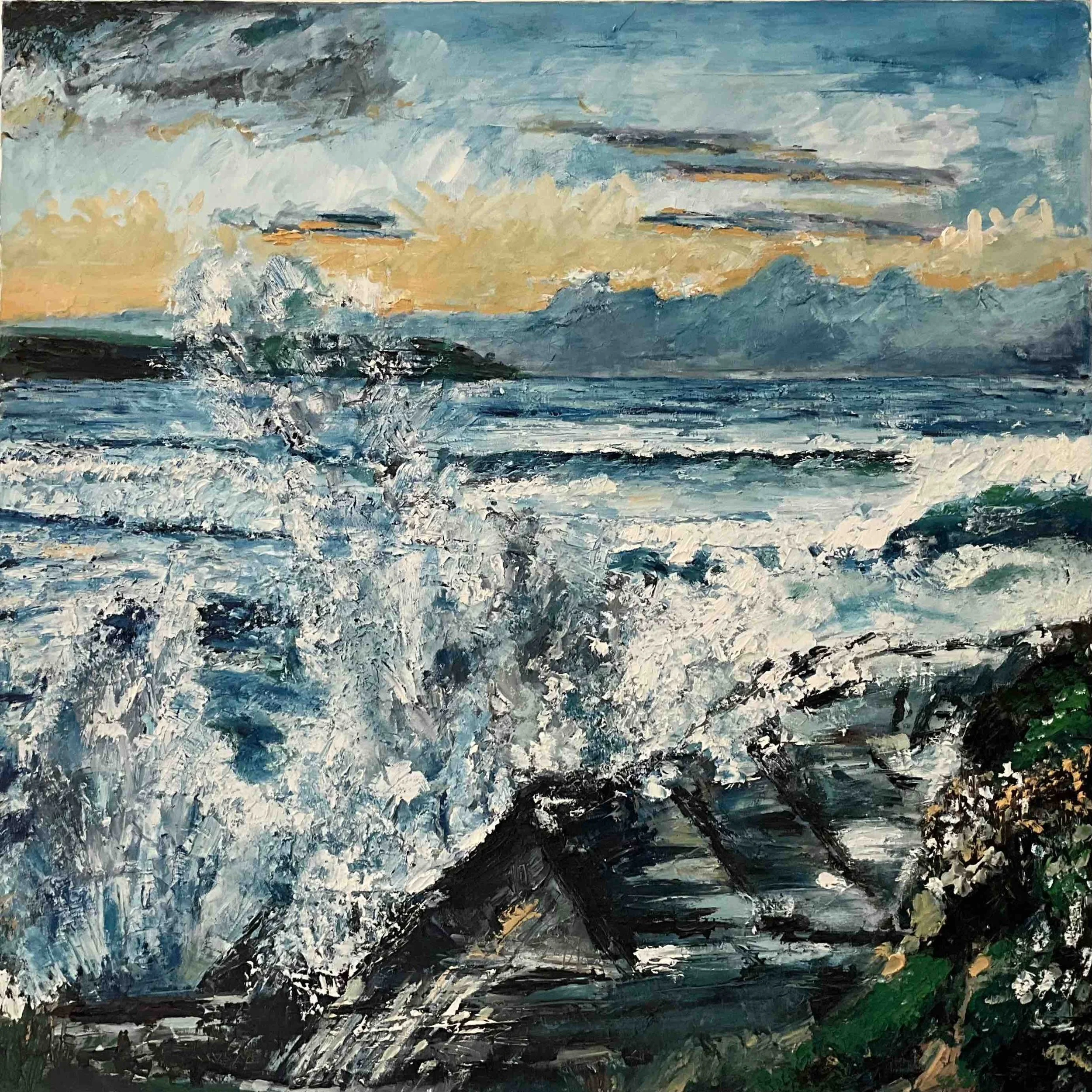
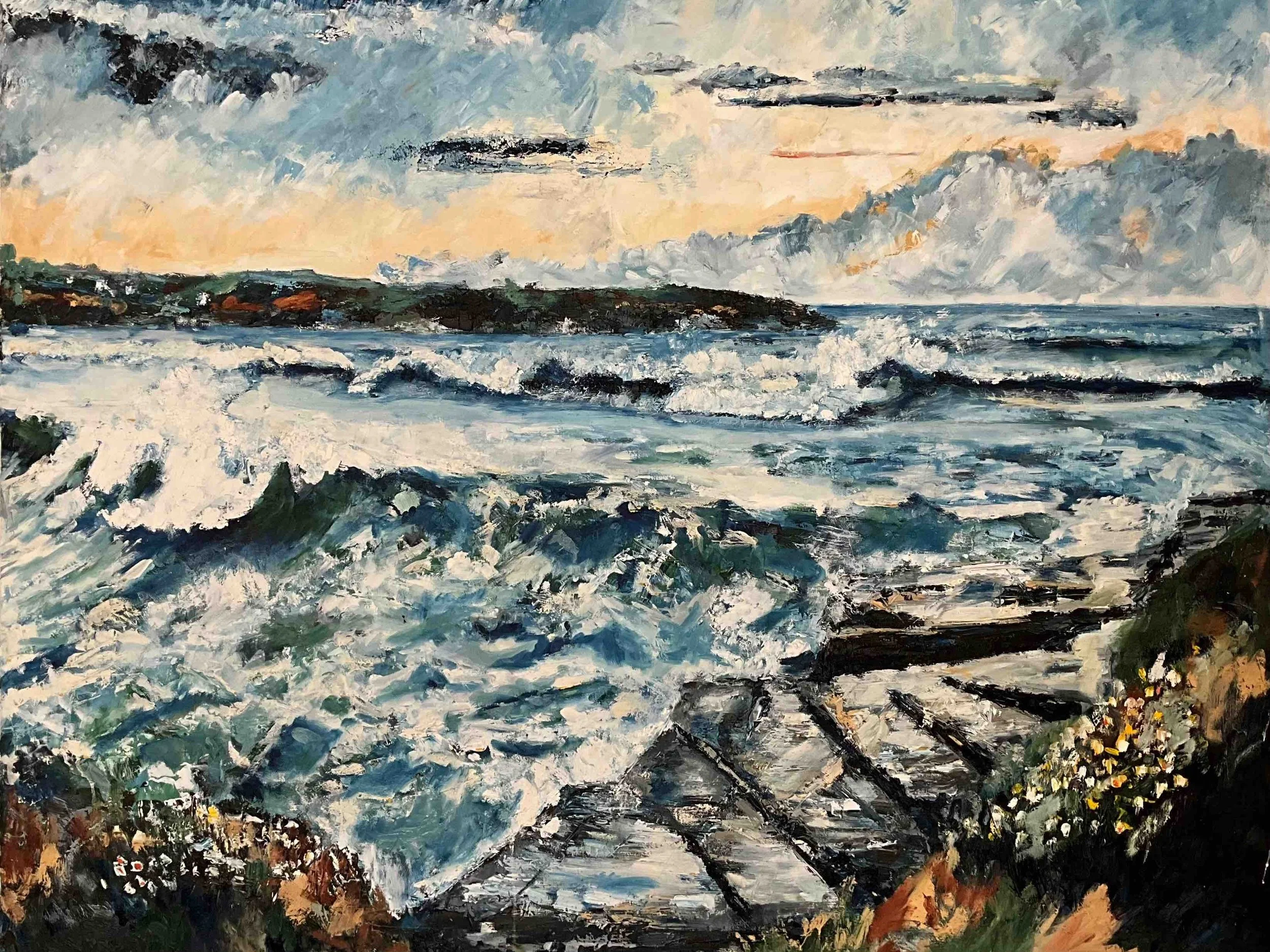
In Harlyn Bay 1, 2, and 3, the groundwork began with thin, tonal washes Prussian blue, Vandyke brown, and terre verte green to lay out the deep trenches of the bay. From there, the painting shifts entirely into physical impasto. Using a combination of heavy hog-bristle brushes and palette knives, the paint is built up directly on the canvas surface.
The white water churned up along Harlyn’s sandbars isn't a flat coat of titanium white; it is broken with cold grey undertones and pale ochre, applied with deliberate, loaded strokes that hold their own physical ridges. When you step close, you see the marks of the knife and the drag of the brush; from across the room, those three-dimensional edges catch the light just like the frothing crest of a breaking wave.
Stripping Away the Postcard
So much coastal painting falls into nostalgic sentimentality safe harbor walls, sunlit deckchairs, or calm turquoise shallows. But anyone who knows Harlyn Bay outside the peak of summer knows that its real power lies in the overcast, moody afternoons when the tide is high and the slate rocks are slick with sea spray.
Across Harlyn Bay 1, 2, and 3, the viewpoint is set low, right at the water’s edge where the foam gathers and retreats. There is no wide, detached horizon to provide an easy escape; instead, the eye is drawn straight into the churn of the mid-ground. The goal was to place the viewer right in the path of the elements, evoking the cold air off the water, the dull roar of the surf, and that momentary suspension of time just before a heavy wave collapses into the bay.
How an Original Oil Behaves in the Home
One of the great advantages of heavily textured oil paintings is that they are never completely static. Unlike a flat print, an original canvas responds continually to the natural light of the room it occupies.
In cool morning light, the deep greens, slate blues, and shadows cut beneath the wave ridges come forward, emphasizing the depth and distance of the sea. As the sun shifts and warmer artificial or evening light takes over, the raised peaks of the impasto pick up highlights, casting minute physical shadows across the face of the canvas. The work adapts to its environment, revealing different brushmarks and nuances of color throughout the day.
Harlyn Bay 1, 2, and 3 are original oils on canvas, finished in my Manchester studio. Detailed photography, canvas dimensions, and purchase inquiries are available through the portfolio archive [https://www.springfieldhousegallery.com/store-1-0/p/tslg0vsd65k0qsd40zvx8msf3e9z60]. Private viewings can also be arranged by appointment.